
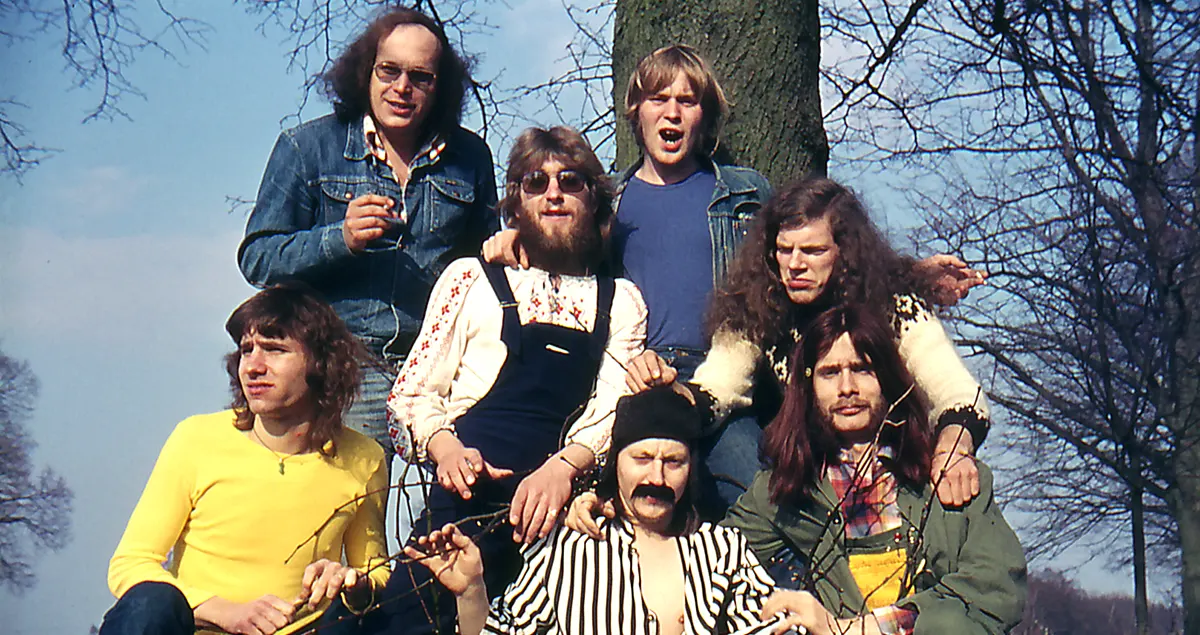
Grobschnitt: Progressive Rock as Absurdist Theatre, Cosmic Improvisation, and German Countercultural Intelligence
Origins and Formation: Progressive Rock Beyond Seriousness
Formed in Hagen, West Germany, in 1970, Grobschnitt occupies a singular and often misunderstood position within progressive rock history. Emerging from the same cultural soil as krautrock yet never fully contained by it, Grobschnitt approached progressiveness not through austerity or academic rigor, but through humor, theatricality, and expansive imagination. Their music rejected the idea that seriousness was a prerequisite for depth.
At a time when progressive rock increasingly equated ambition with gravity, Grobschnitt introduced absurdist intelligence—a willingness to laugh, exaggerate, and perform while still engaging in long-form composition and structural experimentation. This duality placed them outside conventional genre categories: too playful for orthodox prog, too composed for pure krautrock, and too expansive for comedy rock. Their work demonstrates that progress can occur through attitude as much as technique.
Musical Identity and Progressive Characteristics
Grobschnitt’s musical identity is defined by long-form structures, melodic patience, and theatrical contrast. Progressive elements—extended compositions, thematic recurrence, and album-level cohesion—are central, but they coexist with parody, spoken interludes, and exaggerated character work. The result is progressive rock that refuses solemnity without abandoning ambition.
Rhythm in Grobschnitt’s music is flexible and narrative-driven. Grooves may settle into steady motion for extended periods, allowing themes to develop gradually, then dissolve abruptly into silence, dialogue, or stylistic shifts. Time signatures are less important than temporal control—the ability to stretch, suspend, or reset momentum.
Harmonically, the band favors spacious, often modal frameworks. Guitars are lyrical rather than aggressive, supporting atmosphere and gradual build rather than riff dominance. Keyboards contribute symphonic breadth, while bass and drums anchor extended arcs with restraint. The ensemble sound emphasizes continuity, enabling long pieces to unfold without fragmentation.
Vocals occupy a unique role. Rather than functioning purely as melodic delivery, they often act as narrative devices—introducing humor, commentary, or surreal imagery. Lyrics range from poetic and cosmic to deliberately nonsensical, reinforcing the band’s refusal to separate intellect from play.
Progressive Philosophy: Humor as Structural Freedom
Grobschnitt’s progressiveness lies in their understanding that humor destabilizes hierarchy. By refusing to treat their own music with reverence, they create space for genuine experimentation. Laughter becomes a tool of liberation, allowing the band to explore length, repetition, and abstraction without the burden of self-importance.
Albums are conceived as theatrical journeys. Tracks often function as acts within a broader performance, linked by mood, pacing, and conceptual atmosphere rather than explicit narrative. Listening becomes an experience of shifting perspectives rather than linear development.
This philosophy aligns Grobschnitt with a strain of progressive thinking that values imagination over authority. Progress is measured not by technical escalation, but by the ability to sustain curiosity and openness across extended forms.
Ensemble Structure and Creative Dynamics
Grobschnitt operates as a performance-oriented collective. Individual musicianship is strong, yet consistently subordinated to ensemble intent and theatrical timing. Solos are present but rarely indulgent; they serve atmosphere and continuity rather than virtuoso display.
Improvisation plays a role, particularly in extended passages, but it is framed within recognizable structures. The band’s strength lies in managing contrast—balancing stillness and motion, seriousness and parody, immersion and interruption—without collapsing coherence.
This balance enables Grobschnitt to sustain very long compositions while maintaining listener engagement.
Discography Overview: Progressive Rock as Expansive Performance
Grobschnitt (1972)
The debut introduces the band’s core identity: extended tracks, cosmic atmosphere, and a willingness to bend tone and expectation. While raw, it establishes their commitment to duration and mood.
Ballermann (1974)
A more focused and dynamic album, expanding both compositional ambition and theatrical scope. Its variety of textures and pacing reinforces Grobschnitt’s progressive credentials.
Jumbo (1975)
A pivotal release that deepens structural confidence. Long-form pieces unfold patiently, blending melodic development with surreal interjections.
Rockpommel’s Land (1977)
Often regarded as Grobschnitt’s masterpiece, this album presents a cohesive, fairy-tale-like journey built on extended instrumental passages and recurring themes. Its emotional arc demonstrates the band’s ability to balance innocence, humor, and progressive scale.
Later Works
Subsequent albums explore more accessible and stylistically varied territory, yet the band’s core identity—playful imagination within extended form—remains evident.
Signature Track
Solar Music
“Solar Music” stands as Grobschnitt’s definitive progressive statement. Developed and expanded extensively in live performance, the piece exemplifies progress through duration and atmosphere. Built around slow thematic growth, it allows repetition to deepen rather than stagnate.
Instrumental layers accumulate gradually, creating a sense of cosmic drift. Transitions are unhurried, dynamics carefully controlled. Rather than resolving dramatically, the piece sustains a state of openness—embodying Grobschnitt’s belief that progressive rock can function as shared journey rather than destination.
Live Performances and Theatrical Immersion
Grobschnitt’s live performances are central to their legacy. Concerts often transformed compositions into extended communal experiences, incorporating humor, visual gags, and audience interaction without undermining musical focus.
Extended pieces such as “Solar Music” could stretch far beyond studio versions, emphasizing immersion and collective presence. The band’s theatricality enhanced rather than distracted from musical intent, reinforcing the idea that performance itself is a progressive tool.
Influence, Legacy, and Progressive Rock Context
Within the progressive rock canon, Grobschnitt occupies a liminal but vital position. They demonstrate that progressive ambition does not require solemnity or intellectual posturing. Their influence is felt among artists who embrace long-form composition while resisting genre rigidity and self-seriousness.
By integrating humor, fantasy, and theatrical pacing into extended structures, Grobschnitt expanded progressive rock’s emotional and conceptual range—showing that imagination and discipline are not opposites.
Conclusion: Why Grobschnitt Still Matters in Progressive Rock
Grobschnitt still matters because they redefine progressiveness as freedom sustained through form. Their music proves that extended composition can coexist with humor, that theatricality can deepen rather than dilute immersion, and that progressive rock need not posture to be profound.
In a genre often divided between austerity and excess, Grobschnitt offers an alternative path: progressive rock shaped by curiosity, play, and the courage to take imagination seriously without taking oneself too seriously.