
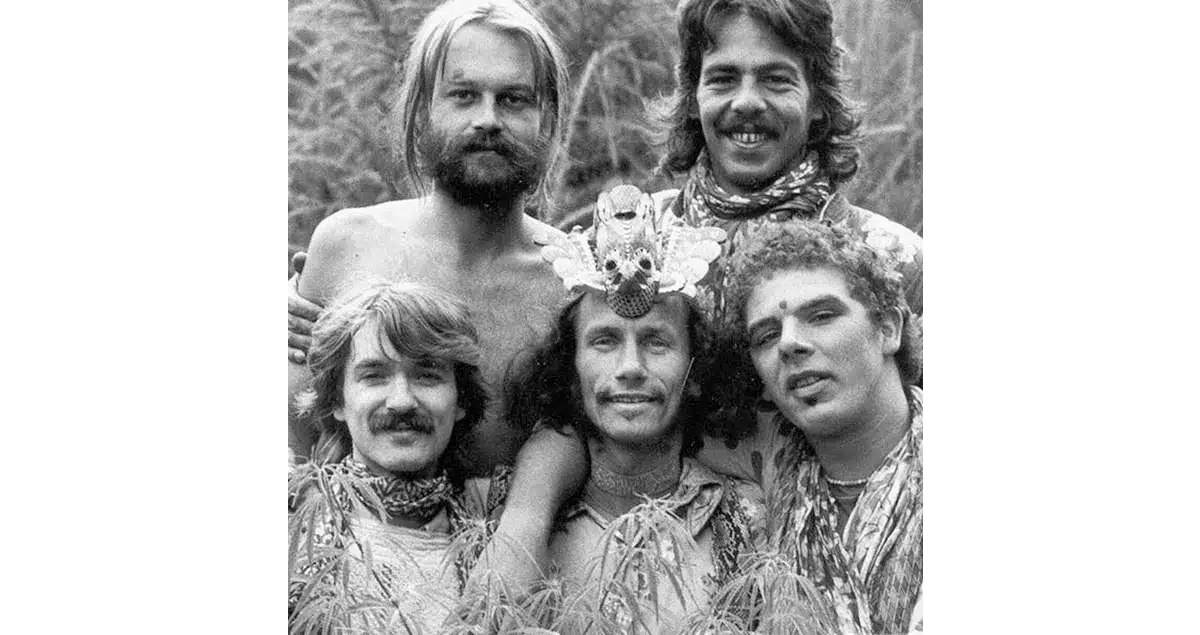
Guru Guru: Progressive Rock as Krautrock Flux, Improvisational Freedom, and Anti-Structure Energy
Origins and Formation: Progressive Rock from Radical Motion
Formed in Heidelberg, Germany, in 1968, Guru Guru occupies a crucial position at the intersection of progressive rock, krautrock, and free-form psychedelia. While British progressive rock pursued refinement, hierarchy, and formal architecture, Guru Guru emerged from a different impulse altogether: movement without permission. Their music was not designed to resolve; it was meant to circulate, mutate, and escape containment.
Born in the cultural aftermath of postwar Germany, Guru Guru rejected inherited rock idioms as well as imported Anglo-American models. Instead, they embraced experimentation as necessity. Progressive rock, in their hands, was not an aesthetic goal but a method of refusal—a way to dismantle predictable form through improvisation, texture, and intensity.
Musical Identity and Progressive Characteristics
Guru Guru’s musical identity is defined by instability, repetition under pressure, and improvisational volatility. Progressive elements—extended duration, ensemble interaction, and thematic persistence—are present, but they operate without classical logic. Rather than developing themes through variation, Guru Guru subjects them to stress and distortion, allowing form to emerge from endurance.
Rhythm is primal and elastic. Grooves may lock in for long stretches, then abruptly dissolve. Drumming alternates between motorik propulsion and free rupture, sustaining momentum while refusing predictability. Time signatures are incidental; pulse is felt physically rather than counted.
Harmonically, Guru Guru resists tonal clarity. Guitar lines oscillate between riff-based insistence and noise-driven abstraction. Bass reinforces repetition as gravitational force. Electronics and effects are treated as organic extensions of the ensemble rather than decorative layers. Sound thickens, thins, fractures, and recombines in real time.
Vocals, when present, are functional rather than expressive. Lyrics often feel secondary—another texture in the mix—reinforcing the band’s emphasis on collective energy over narrative meaning.
Progressive Philosophy: Flux Instead of Form
Guru Guru’s progressiveness lies in their embrace of flux as structure. Where orthodox progressive rock builds upward through composition, Guru Guru moves laterally through persistence and disruption. Progress is not directional; it is kinetic.
Repetition functions as both anchor and trap. Ideas are sustained long enough to become physical, then attacked until they collapse. Improvisation is not a showcase of freedom but a test of endurance and interaction. The music advances through friction—between musicians, between pulse and chaos, between control and release.
Albums are less narratives than fields of activity. Tracks feel like zones entered and exited rather than songs completed. This aligns Guru Guru with krautrock’s broader rejection of Anglo-American rock grammar, positioning them as progressive through method rather than style.
Ensemble Structure and Creative Dynamics
Guru Guru operates as a collision-based ensemble. Individual musicianship is strong, but leadership is unstable. Control shifts moment to moment, depending on energy rather than hierarchy. Solos emerge accidentally, often dissolving before asserting dominance.
Improvisation is central, but not romanticized. It is raw, physical, and occasionally abrasive. The ensemble’s power lies in its willingness to risk collapse—to let momentum outrun structure and discover form afterward.
This approach makes Guru Guru unpredictable, but never passive. Listening requires attention to process, not destination.
Discography Overview: Progressive Rock as Live Matter
UFO (1970)
The debut establishes Guru Guru’s core language immediately: heavy repetition, extended improvisation, and textural aggression. It positions the band closer to ritual than composition.
Hinten (1971)
A more expansive and exploratory album, deepening the band’s improvisational confidence. Grooves stretch longer; abstraction intensifies.
Känguru (1972)
Often cited as a defining release, this album balances propulsion and chaos with greater focus. Repetition becomes more deliberate, while disruption grows sharper.
Guru Guru (1973)
A transitional work that explores funk, satire, and rhythmic experimentation, revealing the band’s openness to mutation without abandoning core principles.
Later Works
Subsequent decades see Guru Guru adapting styles and tones while maintaining their commitment to spontaneity and collective energy. Identity persists through method, not sound.
Signature Track
Oxymoron
“Oxymoron” stands as Guru Guru’s definitive progressive statement. Built on relentless repetition and escalating tension, the piece demonstrates how minimal material can generate overwhelming force through persistence.
Rather than evolving through variation, the track intensifies through pressure. Instruments grind against each other, sustaining motion until texture itself becomes form. The result is progressive rock stripped of narrative—progress through endurance and collision.
Live Performances and Physical Commitment
Guru Guru’s live performances are central to their identity. Concerts emphasize duration, volume, and interaction. Tracks stretch unpredictably, shaped by momentary decisions rather than set plans.
Precision is secondary to presence. Mistakes are absorbed into flow. The music feels alive because it risks failure constantly. Live Guru Guru is not about representation—it is about event.
Influence, Legacy, and Progressive Rock Context
Within the progressive rock landscape, Guru Guru occupies a parallel lineage—aligned with krautrock pioneers who expanded rock by rejecting inherited form. Their influence is evident in experimental rock, noise, psychedelic improvisation, and any progressive tradition that values process over product.
They demonstrated that progressive rock need not aspire to elegance or mastery. It could be raw, unstable, and physical, advancing through motion rather than architecture.
Conclusion: Why Guru Guru Still Matters in Progressive Rock
Guru Guru still matters because they redefine progressiveness as continuous disruption sustained by collective energy. Their music refuses polish, resolution, and hierarchy, offering instead repetition under pressure and improvisation as risk. By treating form as something that emerges from collision rather than design, they expanded progressive rock’s philosophical boundaries.
In a genre often associated with control and precision, Guru Guru stands apart through volatility. Their legacy endures as progressive rock in flux—music that progresses by refusing to stand still long enough to be defined.