
Kraftwerk: Progressive Rock as Conceptual Minimalism, Technology, and the Architecture of the Modern World
Origins and Formation: Progressive Rock Rewritten by Machines
Formed in Düsseldorf in 1970, Kraftwerk represents one of the most profound paradigm shifts in the history of progressive music. While often classified as electronic, Kraftwerk is fundamentally progressive rock at its most radical conclusion—a point where rock’s human-centered identity is deliberately erased and replaced with systems, automation, and conceptual design.
Unlike progressive bands that expanded rock through virtuosity, mythology, or symphonic scale, Kraftwerk dismantled rock entirely and rebuilt it around technology as subject and method. Their work does not merely incorporate machines; it thinks like a machine. In doing so, Kraftwerk permanently altered not only progressive rock, but the entire trajectory of modern music.
Progressiveness, in Kraftwerk’s vision, is not expression—it is design.
Musical Identity and Progressive Characteristics
Kraftwerk’s musical identity is defined by repetition, precision, reduction, and structural purity. Progressive elements—extended form, rejection of traditional song structures, album-level cohesion—are present, but executed through radical minimalism rather than complexity.
Rhythm is mechanical and unwavering. Beats are steady, grid-based, and intentionally emotionless. Rather than groove in the human sense, rhythm functions as infrastructure—a conveyor belt for information. Time does not fluctuate; it persists.
Harmonically, Kraftwerk uses extreme restraint. Chord progressions are simple, often static. Melodic figures repeat obsessively, stripped of ornamentation. Synthesizers replace guitars not to add texture, but to eliminate gesture. Sound becomes symbol.
Vocals are treated as data. Delivered in monotone, often processed, they abandon emotional inflection entirely. Lyrics focus on systems: transportation, communication, energy, identity, Europe, automation. Language is functional, multilingual, and abstracted—speech reduced to interface.
Progressive Philosophy: Progress as System Thinking
Kraftwerk’s progressiveness lies in their transformation of music into conceptual infrastructure. Rather than storytelling or emotional journey, their albums operate as models of modern life. Each record explores a system—mobility, technology, communication, identity—using sound as architectural representation.
This reframes progressive rock as the music of modernity itself. Where classic prog looked backward to myth or outward to fantasy, Kraftwerk looked forward—to highways, computers, robots, and networks. They treated the future not as imagination, but as inevitability.
Repetition is not stagnation; it is automation. Minimalism is not simplicity; it is efficiency. Emotion is not removed—it is deliberately excluded.
Ensemble Structure and Creative Dynamics
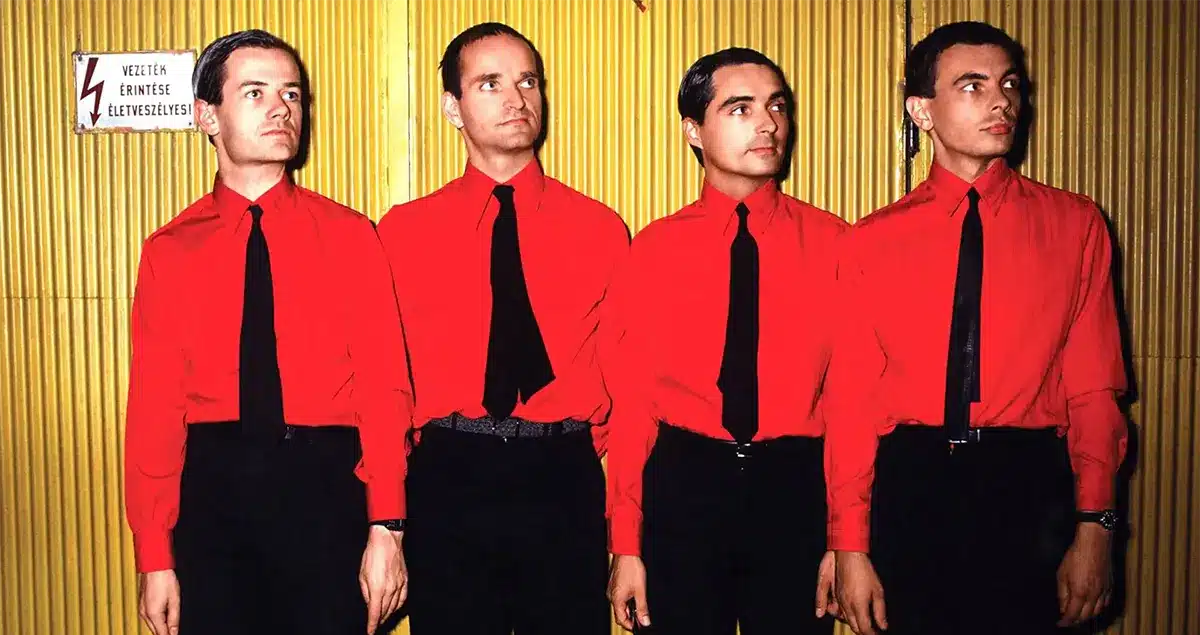
Kraftwerk operates as a non-human ensemble. Individual musicianship is irrelevant by design. The band presents itself as a unit, often visually identical, emphasizing anonymity and interchangeability.
Live performance replaces performance with execution. Movements are minimal. Visuals are geometric, informational, symbolic. The band does not perform music; they run it.
This approach eliminates ego entirely. Progressive rock becomes process, not personality.
Discography Overview: Progressive Rock as Modern Canon
Autobahn (1974)
The breakthrough album that establishes Kraftwerk’s conceptual identity. The title track transforms a highway into sound—repetition as motion, structure as travel. Progressive rock reimagined as infrastructure.
Radio-Activity (1975)
A meditation on energy, transmission, and invisibility. The album functions as an abstract system rather than a collection of songs.
Trans-Europe Express (1977)
Often regarded as Kraftwerk’s masterpiece, this album defines European modern identity through rhythm, repetition, and mechanical elegance. Its influence on progressive, electronic, and hip-hop music is immeasurable.
The Man-Machine (1978)
Kraftwerk fully embraces the concept of human-machine fusion. Music, image, and ideology align into a unified progressive statement.
Computer World (1981)
A prophetic work that anticipates digital life, networks, and data culture. Progressive rock becomes information theory.
Signature Track
Trans-Europe Express
“Trans-Europe Express” stands as Kraftwerk’s definitive progressive statement. Built on repetition, symmetry, and restraint, the track unfolds not through development, but through persistence.
Rhythm functions as rail motion. Harmony remains static. Vocals deliver data-like phrases. The piece does not resolve—it arrives, reinforcing Kraftwerk’s belief that progress is destination, not journey.
Live Performances and Visual Totality
Kraftwerk’s live shows are audiovisual systems. Sound, projection, typography, and motion are unified. There is no improvisation, no spontaneity. Precision is absolute.
Concerts feel less like performances and more like installations—progressive rock transformed into functional art.
Influence, Legacy, and Progressive Rock Canon
Kraftwerk’s influence is total. Electronic music, synth-pop, techno, ambient, hip-hop, post-punk, minimalism—all trace lineage back to Kraftwerk’s conceptual framework.
Within progressive rock history, Kraftwerk represents the genre’s most radical endpoint. They eliminated virtuosity, narrative, emotion, and personality—yet achieved deeper progress than most.
They proved that progressive rock does not need guitars, solos, or even “rock” elements to remain progressive. It only needs ideas executed with absolute consistency.
Conclusion: Why Kraftwerk Still Matters in Progressive Rock
Kraftwerk still matters because they redefine progressiveness as systemic thought made sound. Their music does not express humanity—it documents the world humanity created. By replacing emotion with structure and performance with execution, they transformed progressive rock into a mirror of modern civilization.
In the progressive canon, Kraftwerk stands alone. Not as a band that pushed boundaries—but as one that erased them entirely and rebuilt music from first principles.
Progressive rock did not end with symphonies or epics.
It ended—and began again—with machines thinking in rhythm.