
Tangerine Dream: Progressive Rock as Electronic Continuum and Temporal Expansion
Origins and Formation: The Birth of a Progressive Vision
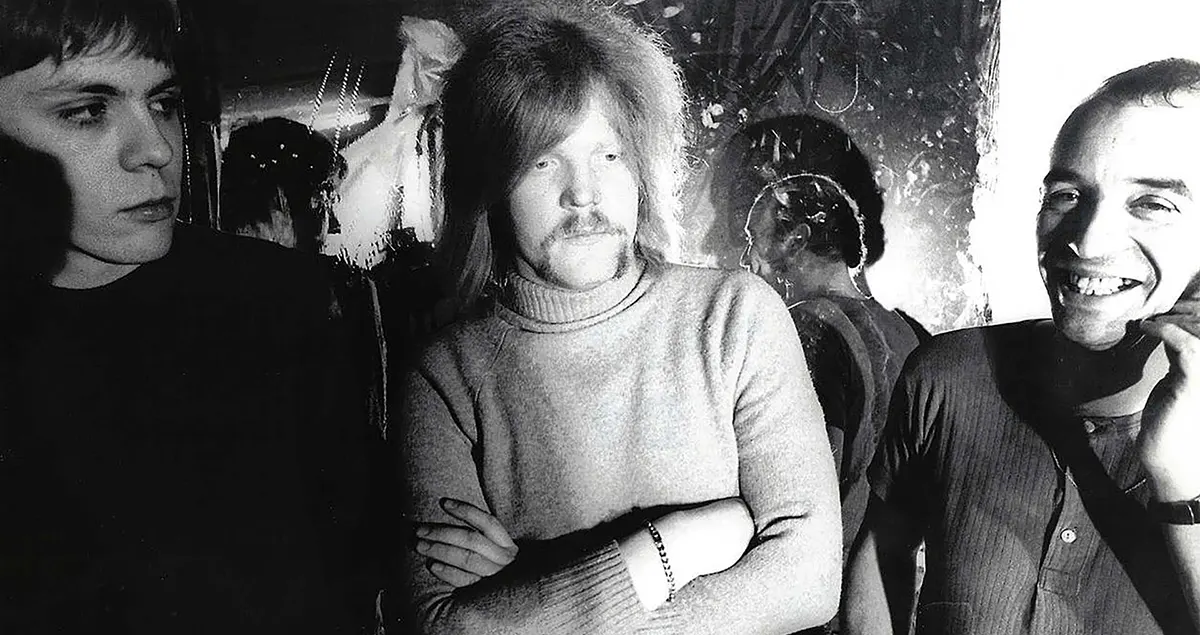
Formed in West Berlin in 1967, Tangerine Dream emerged from a cultural environment defined by experimentation, political tension, and artistic redefinition. Unlike British progressive rock, which evolved from blues, psychedelia, and song-based traditions, Tangerine Dream arose from the European avant-garde, electronic experimentation, and a desire to escape Anglo-American rock conventions entirely.
At its core stood Edgar Froese, whose vision framed music not as performance-driven rock, but as an open-ended process shaped by texture, time, and space. Early incarnations of Tangerine Dream were closer to free-form experimental collectives than bands, engaging with tape manipulation, noise, and improvisation. This formative period established a crucial principle: progressive music did not require guitars, songs, or even rhythm—it required forward motion in thought.
As the group evolved, Tangerine Dream gradually refined chaos into structure, becoming one of the central architects of electronic progressive music. Their work would redefine what “progressive” could mean, not as complexity within rock, but as expansion beyond it.
Musical Identity and Progressive Characteristics
Tangerine Dream’s musical identity is built on duration, transformation, and atmosphere. Rather than composing songs, the group constructs sound environments that evolve slowly over time. Progressive structure exists not through sections or movements, but through gradual modulation—patterns emerge, shift, dissolve, and reassemble.
Rhythm, when present, is cyclical rather than linear. Repetitive sequencer patterns create hypnotic forward motion, replacing traditional meter with pulse. These cycles function as temporal frameworks, allowing harmonic and textural changes to unfold organically above them. The effect is music that moves without destination, embodying progress as continuous flow rather than narrative arc.
Harmonically, Tangerine Dream favors modal and sustained tonal fields. Chords linger, overlap, and mutate, creating emotional ambiguity. Resolution is rarely a goal; instead, tension and release occur through density, timbre, and register. This approach aligns closely with progressive rock’s long-form ambition, translated into an electronic language.
Sound design is central to their identity. Synthesizers are not merely instruments but ecosystems—oscillators, filters, and sequencers interact dynamically, producing music that feels alive and self-generating. This transforms the studio into both composer and performer, pushing progressive rock’s studio-centric tendencies to their logical extreme.
Compositional Philosophy and Collective Process
Tangerine Dream’s approach to composition rejects fixity. Music is treated as a process rather than a product, often developed through improvisation and refined through selection rather than rewriting. This philosophy aligns with progressive rock’s experimental impulse, but diverges sharply from its emphasis on virtuosity or compositional display.
The collective nature of the group reinforces this ethos. While Edgar Froese remained the conceptual anchor, Tangerine Dream functioned as a shifting ensemble rather than a stable lineup. Individual identities are secondary to the sound itself, reinforcing the idea that progressive music can exist independently of personality or performance.
This fluidity allows Tangerine Dream’s music to transcend era and style. Rather than belonging to a single moment, their work exists in a continuum, evolving with technology while maintaining philosophical consistency.
Discography Overview: Albums That Defined an Era
Electronic Meditation (1970)
This debut album captures Tangerine Dream in its most experimental phase. Dense, abstract, and confrontational, it bears little resemblance to later electronic works. Yet it establishes the group’s foundational intent: to reject conventional rock structure and explore sound as raw material.
Zeit (1972)
Often considered one of the most radical statements in progressive music, Zeit abandons rhythm almost entirely. Long, static movements unfold with glacial pace, emphasizing suspension and depth. The album reframes progress as temporal expansion, challenging listeners’ perception of musical time.
Phaedra (1974)
Phaedra marks a pivotal shift toward sequencer-driven composition. Repetitive electronic patterns introduce pulse and motion, creating a balance between structure and abstraction. The album’s success demonstrated that electronic progressive music could achieve both artistic depth and broader recognition.
Rubycon (1975)
Continuing the approach established on Phaedra, Rubycon refines the sequencer-based method into a more cohesive and immersive form. Long-form continuity dominates, reinforcing the idea of albums as uninterrupted journeys rather than collections of pieces.
Stratosfear (1976)
With Stratosfear, Tangerine Dream introduces greater melodic clarity without abandoning progressive depth. The album balances accessibility with atmosphere, representing a mature synthesis of electronic texture and compositional intent.
Tangram (1980)
This album reflects a later evolutionary phase, incorporating digital synthesis and more defined structures. While technologically updated, the music remains rooted in the band’s core philosophy of gradual transformation and continuity.
Signature Track
Phaedra
“Phaedra” stands as Tangerine Dream’s definitive progressive statement. Built around evolving sequencer patterns and shifting harmonic layers, the piece unfolds as a living system rather than a composition in the traditional sense. There is no narrative climax; instead, tension arises from modulation and textural density.
The track exemplifies progressive music as process. Small changes accumulate into large transformations, guiding the listener through an altered perception of time. As a synthesis of electronic innovation and progressive intent, “Phaedra” defines not only the band’s legacy, but an entire branch of progressive music history.
Live Performances and Temporal Improvisation
Tangerine Dream’s live performances function as extensions of their studio philosophy. Rather than reproducing recordings, concerts emphasize real-time creation. Sequencers, synthesizers, and effects are manipulated live, allowing compositions to evolve uniquely in each performance.
This approach reinforces progressive rock’s improvisational heritage while rejecting traditional rock spectacle. Performances are immersive rather than performative, inviting listeners into a shared temporal experience rather than a visual event.
Influence, Legacy, and Progressive Rock Canon
Within the progressive rock canon, Tangerine Dream occupies a foundational yet unconventional position. They represent progressive rock detached from rock itself—progressive as philosophy rather than genre. Their influence extends across electronic music, ambient, film scoring, and contemporary progressive artists who prioritize atmosphere and long-form structure.
They demonstrated that progress in music could mean reduction rather than expansion, repetition rather than variation, electronics rather than guitars. In doing so, they permanently expanded the definition of progressive music.
Conclusion: Why Tangerine Dream Still Matters in Progressive Rock
Tangerine Dream still matters because they redefined progress as continuity. Their music does not seek resolution, climax, or narrative—it seeks immersion. By treating time as the primary compositional material, they transformed progressive rock’s ambition into an electronic continuum.
In the history of progressive music, Tangerine Dream stands as proof that progress is not bound to form or instrumentation. It is bound to intent—the courage to move forward without reference. Their legacy endures not as nostalgia, but as motion itself: endless, unfolding, and fundamentally progressive.